Christina: Steve and I don't do a lot of collaborative posts; it just takes a bit too much coordination :) But here is one that came out of many discussions we have had over the years. We all have war stories, things that have gone bad fast. Sometimes it's our fault, sometimes it's not. But statistics support that MOST of the time it is the system's (methodology’s) fault. A broken methodology will repeatedly put even the best consultants in frustrating situations. Here are just a handful of examples where Sure Step, or any formal implementation methodology, could avoid frustration and disappointment.
Steve: A few times I've received a call from a partner asking for assistance--but with a twist. It starts out with a seemingly normal request for assistance with a Dynamics GP integration or customization. Then I'm asked if I can work on the project "right away". And then I'm asked if I can discount my billing rate.
That's when the alarm bells go off. On subsequent calls, I start to learn the project has some serious issues, and I'm being brought in at the last minute to try and salvage an integration or customization that someone didn't complete or is broken.
Based on two of these experiences, I thought I would give Christina, a SureStep Guru, a challenge. I'll document some observations of a few projects-in-crisis that I've worked on, and she will map the symptoms to elements of the Sure Step methodology that might have helped avoid the breakdowns.
Scenario 1: "Steve, can you help us with this integration ASAP? We have some code that a developer at an offshore firm wrote, but it doesn't seem to work and they haven't returned any calls or e-mails in 3 weeks, when the development firm said they were transitioning to a new developer. Oh, and can you do us a favor and drop your rates 40%? We're already way over budget, are weeks behind schedule, our go live is in two weeks, and the client is very upset that the integration doesn't work and can't be tested. We're relying on you to help us out."
True story! With friends like these, who needs enemies?
So Christina, how could Sure Step have helped this partner and customer? (and me!)
Solution 1: First, if we were to open Sure Step, and look under Project Types and Implementation Phases for an Enterprise Project Type, we find activities that could address the scenario above. Selecting an activity will display guidance, templates, and other resources in the right hand pane.
First, under 1.1.2, we see the project management discipline of Risk Management. Active risk management should have identified the potential risks of using offshore resources. And while we are talking about PM disciplines, how about Communications Management (1.1.3), which would include Project Performance and Status Reporting that should have identified potential budget issues before they actually occurred.
Now, if we skip down further in Sure Step, under Additional Resources, we find guidance on an Onsite/Offshore Conceptual Work Split. Was this discussed with the offshore developers? Were standards discussed and then managed proactively following the disciplines we discussed above?
Now, back under Project Types and Implementation Phases, in the Design Phase, there are also a number of activities related to customization design.
Where is the functional design in the scenario above? Was it signed off on by the customer? Did the developer create a technical design? Where is it? How about testing? Who did it and when? All of these set expectations of what the design includes, and make it easier to transition work when a resource is no longer available. These activities may be the responsibility of the developer and other consultants, but with active project management we can easily identify when these tasks don’t happen and manage the outcome.
Scenario 2: "Hey Steve, I hope you are available right away, because we really need your help. We were working with a third party company to help our client perform a multi-year detailed historical data conversion from their legacy accounting system to Dynamics GP, including project accounting transactions that will be migrated to Analytical Accounting transactions in GP. The vendor was supposed to deliver all of the converted data last Friday, but they called us this weekend to say that they can't read the source data and won't be able to deliver the GP data. We're hoping you can help us figure out how to extract the data from their old system and then import it into GP in the next 4 days since we're behind schedule. The client is not happy and we have already reduced our rates, so can you reduce your rate? Oh, and I had an expectation that this could all be done in less than 10 hours, because the client won't be happy having to pay much more for this conversion since we're already far over budget--will 10 hours be enough?"
Seriously, I can't make this stuff up. I've always wondered how people can keep a straight face while saying both "We really really need you to rescue us from a disaster" and "Can you dramatically lower your billing rate because we're over budget" in the same breath.
Christina, the stage is yours...
Solution 2: Well, this seems like a project with no analysis phase, no design phase, no development phase, just a deployment and operation phase. Sure Step prescribes 5 phases to an implementation project (the first phase, Diagnostic, is a pre-sales phase), and all projects do have all phases (although the length of each phase can vary based on the project).
Activities in Sure Step are laid out by phase, as shown in the screenshot below. There are also a number of cross phase processes, which are activities (like Quality and Testing) which span multiple phases. By following this structure, we can ensure that tasks are completed in a logic order and that activities do not occur without the proper planning.
The Analysis phase is the information-gathering phase, and would include tasks like gathering data migration requirements and developing testing standards. While the Design phase includes activities for the functional and technical design of data migration include the tasks outlined in the screenshot below.
By completing Analysis and Design BEFORE actual development is needed, we can avoid the surprises regarding how to extract the data and the required format for import in to the system. Sure Step uses this measured approach specifically to discourage skipping right to development and deployment. And in the case of the scenario above, it seems that development was combined with deployment, leaving out critical Development phase tasks like data acceptance testing.
Scenario 3: "Steve, I need you to modify these 6 Dynamics GP and ISV windows to selectively disable certain buttons and certain fields for certain users. I don't want certain users accidentally changing or deleting data on these windows, so let's disable the Delete and Save buttons, and then make certain fields read only just in case. Hmmm, can you password protect a few fields as well? And Dynamics GP doesn't work the same way as their 20 year old custom AS400 system that is being replaced, so we need you to create a few custom windows to replicate their AS400 screens, and then modify the transaction workflow to match their old system. After you are done with that, we can talk about how we can get the Dynamics GP reports to look exactly like the AS400 reports they are currently using. I know that none of these changes are included in the statement of work and that we had 10 people participating in 2 weeks of system design meetings agree that we wouldn't need any customizations or modifications, but I think we really need Dynamics GP to work just like the AS400 system. Let's call these change request number 97 and 98 for now. I'll reserve numbers 99 through 120 for the reporting."
Christina, I just deliver them on a silver platter, and rely on you to work your Sure Step magic.
Solution 3: Oooookay. Well, although this has an element of lack of functional design to it, I think the real underlying issue is Detailed Business Process Analysis. If we look at the Analysis phase activity for Conduct Detailed Business Process Analysis (1.3.1), we see three key tasks.
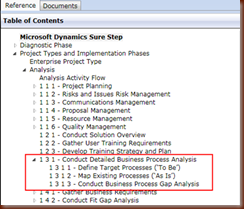
Sure Step advocates for this three step process that begins with "Define Target Process (To Be)" and then moves to "Map Existing Processes (As Is)" and then analyzing any gaps. And preceding this, we can also include (per Sure Step) a solutions overview to acquaint keys users with how the systems works "out of the box". Why do we do this? Why do we start with Defining Target Processes? Because we are changing systems which means we will be changing our processes. I know that may seem like an obvious statement, but it is not unusual for organizations and individuals to react negatively to the potential for change. That is why Sure Step even has guidance in the Project Management Library (and throughout the activities as well) regarding Organization Change Management (OCM).

The guidance in Sure Step related to OCM will assist in the project team in helping the client navigate and manage the necessary organizational change that comes with implementing a new software system. Stories like the one above suggest to me that Organization Change Management was not considered as an important activity, and that the client is scared in to wanting to recreate their existing system. Personally, I take the word "consultant" seriously. We are there to consult, and advise, on the best practice. And Sure Step helps you do that in a way that can improve results, minimize risk, and increase project success.
Well, hope you found this scenario/solution format helpful. As always, we love to hear from any of our readers out there. And I love to hear about how you are using Sure Step (even in bits and pieces) to better your processes.


